Christian Theology and the Degradation of the Environment
“Going deeper, I realize that divestment of the separation between humans and non-human nature means having as benign a presence as possible on the earth.”
I am writing to you from the seized territory of the Eno, Tutelo, Saponi, Occaneechi, and the Shakori peoples. The Occaneechi Band of the Saponi Nation, an umbrella title for most of the tribes in this area, would like everyone to know that “this land does not belong to man; we belong to the land. The Occaneechi People (The Ye’sah), ask that you will keep these thoughts in mind, while here in place, and treat it with the respect, love, and care that our Ancestors did, and as we do so today.
I am a white settler American with a Christian background. I am not sure where each of my readers are from, but I would dare to say that those with a western background like me have been greatly influenced by Christian theology. This is a paper about Christian theology and the part it has played and is playing in the current environmental crisis and it will share some ideas of ways we can bring about a change of mind. I am starting with two verses from the Hebrew and Christian scriptures.
“Then God said, ‘Let us make mankind in our image, in our likeness, so that they may rule over the fish in the sea and the birds in the sky, over the livestock and all the wild animals, and over all the creatures that move along the ground….God blessed them and said to them, ‘Be fruitful and increase in number; fill the earth and subdue it. Rule over the fish of the sea and the birds in the sky and over every living creature that moves on the ground.” Genesis 1:26 and 28 (NIV)[1]
“Then I saw a new heaven and a new earth, for the first heaven and the first earth had passed away, and the sea was no more.” Revelation 21:1 (ESV)[2]
I grew up in a strict but very theologically typical conservative evangelical community. I found great pleasure in playing outdoors, following my imagination, and soaking in the beauty of the forest and the beach. Rather than being able to celebrate my connection to nature, however, I felt guilty about it. The only way I could assuage my guilt was to try hard to stay focused on verbal prayers to God while I was walking through the woods or down the beach. I could not simply indulge in enjoying nature for what it was in its essence. I also believed, as I was taught, that it was all going to burn up one day at the command of God. Environmentalism did not make sense to me. Why recycle or try to take care of the land and eco systems around us if the earth would soon be gone?
The verses above are two of the most earth-damaging verses in the Christian Bible when taken out of their contexts and applied to humans’ responsibility toward the earth and to their relationship with more than human nature. This paper will explore how Christian theology has led many to believe, contrary to many other worldviews, that humans are superior to the rest of nature and get to use their power in whatever ways benefit them regardless of more than human nature. This has been a significant contributing factor to the climate crisis in which we find ourselves. The paper will also briefly look at some other perspectives that can be helpful for us as we compost some of the unhelpful Christian/western perspectives on our role in the environment that can help us reshape our mindset in ways that can lead to positive change.
A Couple of Christian Perspectives
Protestant/Evangelical
A quick internet search for evangelical views on humans’ relationship to our environment will yield a large supply of articles about creation care[3] and stewardship of the earth.[4] Go-to sites for evangelicals will often quickly suggest that readers not pay undue homage to the earth[5] or get too carried away with the secondary issue of environmentalism.[6] Afterall, according to Genesis 1:28, we are to subdue and have dominion over the earth.
It is unfair to evangelicals to not dig deeper than the popular clickbait. In Wayne Grudem’s Systematic Theology, he writes pages detailing the ways humans are morally, spiritually, mentally, relationally and physically superior to animals because we are made in God’s image. He ends his section on the uniqueness of humans by saying that if we deny this unique status, we will depreciate the value of human life and see humans as merely a higher form of animal and will treat each other as animals.[7]
Another evangelical take is found in Old Testament Ethics for the People of God by Christopher J. H. Wright. He also affirms that it is clear there is a specialness to humans. Only humans are told they are created in the image of God, therefore only humans are in God’s image. He argues that the mandate to have dominion over the earth is not a stewardship role, but a kingship role. Humans are to be benevolent rulers who protect the rest of creation which is weak and vulnerable.[8]
Protestant fathers set a precedent for evangelicals in their understanding of humans’ relationship to more than human nature. While Martin Luther affirms a strong similarity between many animals and humans, he argues that since humans were made in God’s image, we have far superior lives than any other creature. Luther continues by also affirming humans’ dominion over the rest of creation and speaking of it as a lordship or kingship. He also speaks of how great the difference is between humans and animals especially before the fall. He goes so far as to say that since the fall, we have lost much of our control over nature. That now it is much less than it would have been. We should have more control than we do.[9]
The Genesis verses about the origins of humanity and their responsibility toward the rest of creation have been found to cause apathy in evangelical circles toward environmental justice. On the other hand, some Christian circles argue that the opposite is true—that these same verses support environmental justice and special care for creation and that they therefore practice accordingly. David C. Barker and David H. Bearce show in an extensive 2013 study that it is not the beginning of the Bible that causes the most apathy about the environment among American evangelicals, but the end. Through their research, they found that believers in the rapture at the end times (especially those who believe the rapture comes before the ultimate destruction of earth) were far less likely to care about environmental degradation. They view it as inevitable and even welcome as a signal that Jesus will soon return and are therefore unlikely to do anything personally or policy-wise that may lead to reversing the results of climate change. This view of the end times is less than 100 years old but was popularized and widely disseminated by the trendy Left Behind series by Tim LaHaye.[10]
Orthodox
Lynn White Jr, a Presbyterian layman, argues that Christianity itself, not Western modernity, is responsible for the environmental crisis we find ourselves in. He, however, exempts the Christianity of the East from his censure. He believes the Church of the Greek East views nature as a “symbolic system through which God speaks to men.”[11] Creation was not meant to be a commodity for humans’ consumption, but as a love poem from God to humans.[12]
St. Dionysius, Church Father of the 5th or 6th century, proposes the idea of hierarchy in nature. Today, the word hierarchy often means domination and exploitation. However, when Dionysius coined the term, he meant “continuity rather than opposition between higher and lower orders of beings and beneficent and grateful love rather than domination and subservience as the relation between them.”[13] He believed it was this hierarchy that made it possible for us to value all things as being in God and is that which shows us that all things love God as well. Indeed, if we can find all things in God at their appropriate levels (hierarchy), then we cannot see any one thing as an object for our selfish use but will see it as sacred.[14]
A more current Orthodox witness, Elizabeth Theokritoff, believes we must inhabit the earth as mindful beings of the whole of creation, humanity in particular. Humanity would not exist without the rest of creation.[15] She argues that all nature, human or otherwise, is inextricably connected. Our globalized world now reveals that damage to one corner of the earth has ripple effects on the distant opposite corner. Theokritoff highlights the work of St. Maximus and his message of a “loving affinity that unites all things, grounded in the Creator’s invisible and unknown presence in all things.”[16]
Current Crisis
We are in a time of global crisis. We have come to the end of 10,000 years of climate stability and are moving into a human-induced climate crisis. With the shift in global temperature, we are seeing extreme weather such as droughts, hurricanes, heat waves, and drier conditions that cause fires and floods. Sea levels are rising, ice caps are melting, and rainforests are being destroyed. Attempts to address this globally on a political level have failed due to slow-moving policies and undue politicization of the climate crisis issue. This crisis has a greater impact on poor nations than wealthier ones even though the emissions from poorer nations are far below those of wealthier nations. Among these more vulnerable communities and nations, there is an average of more than 50,000 deaths due to climate change per year since 2010 and that number is expected to rise exponentially. These vulnerable communities are losing billions of dollars because of the climate crisis. In addition, rising sea levels, which have already displaced hundreds of thousands of people, disproportionately affect these poorer communities and island countries.[17]
The climate crisis does not just affect the weather. Climate change is considered a “threat multiplier” causing not just erratic weather, but infectious disease outbreaks, food and water insecurity, biodiversity loss, and involuntary displacement. There are studies showing that climate change triggered a series of changes in bat habitats in the southern Chinese Province of Yunnan that may have been what caused initial coronavirus outbreaks, for instance.[18] Food security is directly affected by climate change as temperatures rise and crop production suffers. Climate change also affects globalization, urbanization, distribution structures, and affordability which all lead to further food insecurity.[19] The chain reactions triggered by climate change are endless.
Let’s Make a Mindset Shift
I would like to propose that when we find out a mindset or theology is unhelpful or damaging that we find ways to change it. We have many places to look to find alternative views that can be more helpful. We’ll look at a few here. I am very aware that these overviews are greatly simplified.
An Ancient Perspective
In ancient China, poetry and other artifacts are found revealing a complex relationship between human and non-human nature. It is one of both dependence and struggle. Humans needed animals for food. However, they also viewed animals, plants, heavenly bodies, and natural forces as family or ancestors. This is how totemism was born, the totem not being deity in the beginning but something unexplainable and thus to be revered. The mystery held by non-human nature led to the belief that nature is alive with spirits or souls. The fearful events of nature led to beliefs in ill-willed goblins around this time as well (probably late paleolithic era). On the one hand, humans found the need to petition these mysterious forces of nature to work in their favor, and on the other, they did their best to exert their will over nature to get their desired outcomes. Indeed, historians believe nature is the original object of religion as it changed from a recipient of mere reverence to an object of worship when agriculture and animal husbandry were established (around the turn of the neolithic era). Reverence morphed into worship as humans sought divine cooperation with their efforts to control outcomes for their own survival.[20]
An Indigenous Perspective
Kaimana Barcarse is a Hawaiian who uses his many talents and community roles to improve the well-being of Hawaiians through a healthy community ecosystem. His desire is to help maintain the rich indigenous perspectives of his people.[21] He defines the indigenous perspective as backwoods, archaic, and simplistic. By backwoods, he means that it is an interdependent way of co-existing with nature. It is an existence that is neither invasive nor destructive. The indigenous perspective is archaic in the sense that it is tried and tested over centuries. He does not understand why lack of progress is so terrible when he sees where progress has brought our environment. By simplistic, he means it is uncomplicated and sure. He has seen these indigenous perspectives used to revitalize the island of Huahine in the nation of Tahiti. The island once striped of its natural resources due to overfishing, harvesting, and gathering, has been restored in a few years to its original abundance using the ancient, indigenous practices of hunting, gathering, and growing. Two relevant Hawaiian sayings are: “The land is the chief, and man is but his servant” and “If the land lives, so shall we.”[22]
A Scientific Perspective
More scientific research is coming to the fore that focuses on human animality. Scientific writer and researcher, Melanie Challenger writes that we do not have a monopoly on valuable lived experiences among the animals (because, of course, from a scientific perspective, we are unquestionably animals). She argues that as we are on the edge of this biodiversity crisis leading to the environmental crisis, we must rethink what is precious to us about our animal lives.[23]
Alternative Christian Perspectives
There is another view emerging in Christian spaces that differs from the separation between humans and non-human nature view based on the image of God verses. In his book Inner Animalities: Theology and the End of the Human, Catholic theologian Eric Daryl Meyer argues that there must be a fundamental shift in our understanding of ourselves as we relate to creation and other creatures.[24] Meyer asks the question, “What has prevented Christianity from becoming a site of effective resistance to ecological degradation?” His conclusion is that Christian theology is so invested in a clear distinction between animals and humans that Christians cannot see where we creatures are enmeshed and therefore do not resist the demise of the environment. He argues that until Christian theology releases itself from this commitment to the separation of human and animal and centers itself on human animality, any efforts to help the environment will be ineffective and harmful. He goes even further to say that until we accept the animality of God, we will not hear the voice of the Spirit through non-human nature that will lead us in hopeful directions.[25]
Thomas Berry is another notable figure who crosses boundaries in Christianity and other world religions. He is often considered the grandfather of the environmental ethics movement,[26] though his work expanded beyond ecology to history and extensive study of world religions. One of his biggest contributions to the world of eco-theology is a call for humans to transition from being a disruptive force on the earth to being a benign one. He believed that humans have donegreat damage to our environment and should stop dominating and simply know what our place is with the rest of nature.[27]
Melanie L. Harris is a Christian ecowomanist who seeks to bring consciousness to the intersection of social justice and eco-justice. She is calling the church to recognize the injustices of the past and how the earth is mirroring those injustices to us now through an increase in storms, floods, and fires. She wants Christians to see the resemblance between the violence of slavery and sharecropping of the past and the dominance that is at work in the anthropocentric outlook popular in Christian theology that reduces everything except humans to an unimportant other.[28]
Aminah Al-Attas Bradford—an ecowomanist who works at the intersection of science, faith, and race—argues that Christians have even scapegoated the smallest of the animals—the microbe/the germ—as a way of explaining why there is pain in the world even in the presence of a loving, all-powerful God. This idea takes the separation that Christian theology has created between humans and animals to the very minutiae of everyday life. She sees theologians turning toward the study of the microbe as a way of disrupting the prevailing and long-standing anthropocentric way of viewing our relationship to anything non-human. Al-Attas Bradford suggests that humanity’s complete dependence on microbes counters the age-old Christian theology that uses the image of God language “as the primary psychological wedge between humanity and its responsibility to animal and environmental life.”[29]
Change Our Theology
This paper very briefly overviews just a few theological perspectives on the environment that Christians have shared over the centuries. It is apparent that Christians’ apathy (which seems to have spread to the broader culture) about the world around us and the current environmental crisis is due to our idea of a deep separation between human and non-human nature from the tiniest bacteria to dogs to Mt. Everest. Even the gentler Orthodox theology centers humans in their theology and perspective of the earth and its interaction with God. More recently, a particular theology about end times has also created apathy. Our theology does not align with reality. Theology is a human construct, not God-ordained; therefore, we can and should change it. As Eric Daryl Meyer says, “The problem of human animality is not essential to Christian theology—Christian theology can think otherwise—and yet, the heritage of this problem has persistently shaped Christian thought for millennia.” [30]
In his book Inner Animalities: Theology and the End of the Human, Meyer suggests we change our theology based in anthropological exceptionalism to one where human identity is grounded in animality. This will begin to address the ecological concerns of the earth and the well-being of all its creatures. It would shift our belief that the world is being destroyed from something outside it (as in end-times theology) and help us see this is an ecological apocalypse of our own making and one we cannot address until we understand the human/non-human nature connection. [31] He believes, “Until Christian theology surrenders its investment in a categorical human-animal distinction and correctively centers its theological anthropology on human animality, Christian resistance to ecological degradation will be ineffective and contradictory.” [32]
Reflection
I shifted a few years ago to the perspective that the Bible is not inerrant and is deeply human. However, it was difficult to find—even in the progressive spaces I wandered into at times—a deconstruction of the image of God idea. There is something deep in us that fears the lack of distinction between humans and non-human nature. We cling to the desire for specialness, uniqueness. I have been overjoyed to find a different perspective! Why does the exaltation of one mean the casting down of the other? And to play with the idea of the animality of God as opposed to the idea of “animal” as lesser than or gross in some way is thrilling.
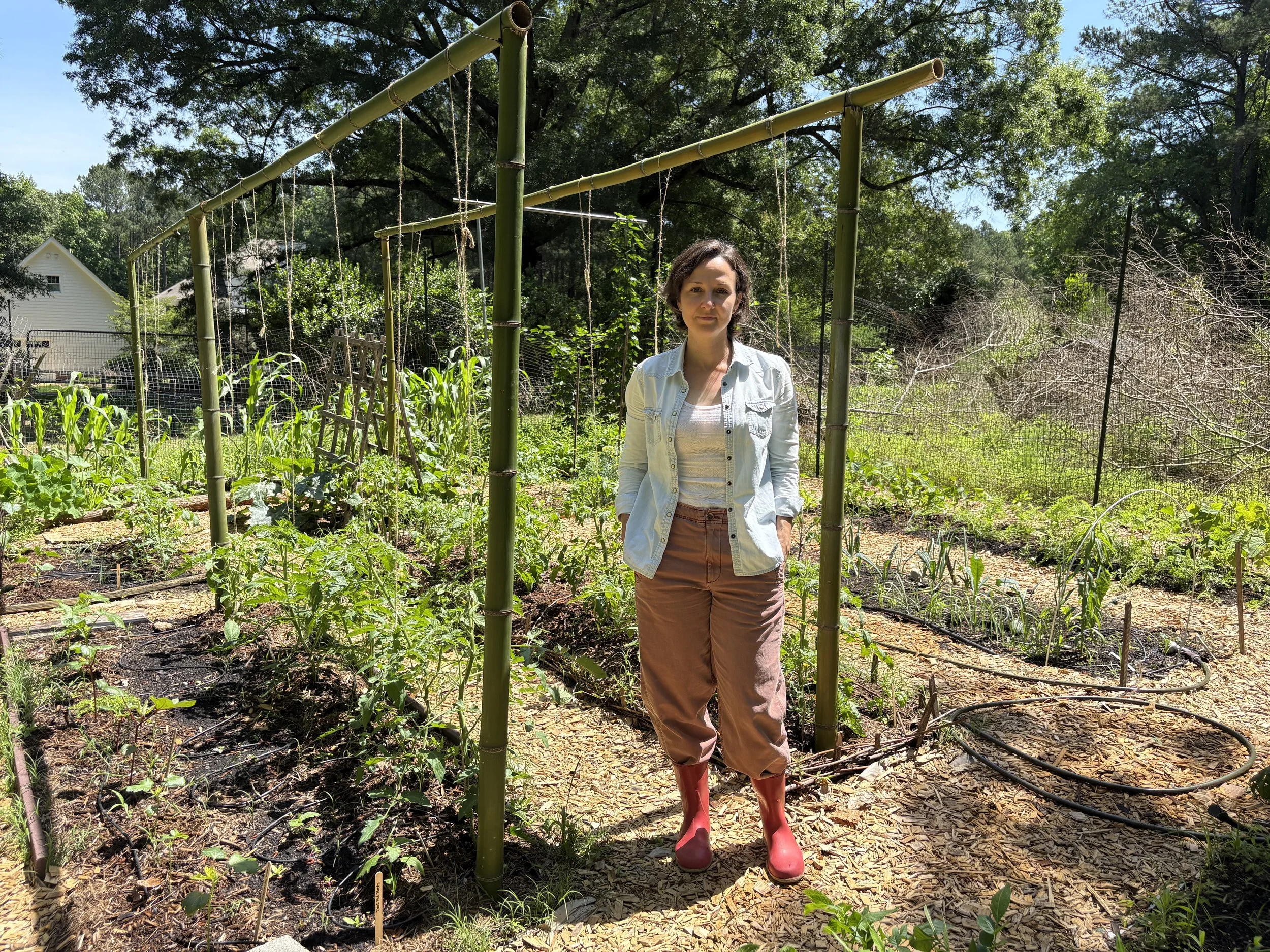
My changing theology has practical implications. I will continue to lean into my awe of the earth and all its creatures. I will seek to farm in a way that works with nature and not against it. And as I am with everything I get excited about, I will be evangelistic about my changing theology—I will share it with anyone who has a pinch of interest.
Going deeper, I realize that divestment of the separation between humans and non-human nature means having as benign a presence as possible on the earth. I will seek to shrink my sphere of influence (setting aside my will to make space for other wills) as much as possible by simplifying life (less stuff), buying locally, eating seasonally, and traveling as little as possible. I will also seek ways to help change policies around farming, land usage, nature preservation, animal rights, and urban planning. This is one of those journeys that will take a lifetime both to understand the change in theology as well as to implement the practical implications of that changed theology.
The Peace of Wild Things
When despair for the world grows in me
and I wake in the night at the least sound
in fear of what my life and my children’s lives may be,
I go and lie down where the wood drake
rests in his beauty on the water, and the great heron feeds.
I come into the peace of wild things
who do not tax their lives with forethough
of grief. I come into the presence of still water.
And I feel above me the day-blind stars
waiting with their light. For a time
I rest in the grace of the world, and am free.
~Wendell Berry[33]
[1] Genesis 1:26 and 28, NIV
[2] Revelation 21:1, ESV
[3] “Creation Care,” Christianity Today, Google, https://www.christianitytoday.com/ct/topics/c/creation-care/.
[4] “Stewardship of the Earth,” Wycliffe Global Alliance, https://www.wycliffe.net/more-about-what-we-do/philosophy-and-principle-papers/stewardship-of-the-earth/.
[5] “How Should Christians Respond to Climate Change?” Desiring God, last modified June 12, 2020, https://www.desiringgod.org/interviews/how-should-christians-respond-to-climate-change.
[6] “Evangelicals and the Environment,” The Gospel Coalition, Last modified February 8, 2018, https://ca.thegospelcoalition.org/article/evangelicals-and-the-environment/.
[7] Wayne Grudem, Systematic Theology (Leicester, England: Inter-Varsity Press and Grand Rapids, Michigan: Zondervan, 1994), 445-50.
[8] Christopher J. H. Wright, Old Testament Ethics for the People of God (Downers Grove, Illinois: InterVarsity Press, 2004), 118-29.
[9] “Martin Luther’s Commentary: Genesis Chapter 1-4,” https://www.wolfmueller.co/wp-content/uploads/2017/08/Genesis1-4Study.pdf.
[10] “End-Times Theology, the Shadow of the Future, and Public Resistance to Addressing Global Climate Change,” JSTOR, last modified in 2013, https://www.jstor.org/stable/23563143?read-now=1&seq=9#page_scan_tab_contents.
[11] John Chryssavgis and Bruce V. Foltz, “Introduction,” in Toward an Ecology of Transfiguration, ed. John Chryssavgis and Bruce V. Foltz (New York: Fordham University Press, 2013), p. 2.
[12] Ibid., p. 3.
[13] Eric D. Perl, “Hierarchy and Love in St. Dionysius the Areopagite,” in Toward an Ecology of Transfiguration, ed. John Chryssavgis and Bruce V. Foltz (New York: Fordham University Press, 2013), p. 24.
[14] Ibid., pp. 23-33.
[15] Elizabeth Theokritoff, Living in God’s Creation: Orthodox Perspectives on Ecology (Crestwood, New York: St. Vladimir’s Seminary Press, 2009), p. 9.
[16] Ibid, p. 248.
[17] “Understanding the Correlation Between Climate Change and the COVID-19 Pandemic Crisis,” JSTOR, last modified October 21, 2021, https://www.jstor.org/stable/resrep36739?searchText=global+climate+crisis+explained&searchUri=%2Faction%2FdoBasicSearch%3FQuery%3Dglobal%2Bclimate%2Bcrisis%2Bexplained&ab_segments=0%2FSYC-6704_basic_search%2Fcontrol&refreqid=fastly-default%3A294b4852bb5cb2abdef3c116efaccc5a#metadata_info_tab_contents.
[18] Ibid.
[19] “Climate Change and Food Security,” JSTOR, last modified October 24, 2005, https://www.jstor.org/stable/30041400?read-now=1&seq=1#page_scan_tab_contents.
[20] “Nature and Religion in Ancient Chinese Poetry,” JSTOR, last modified in 2003, https://www.jstor.org/stable/41933321?seq=10#metadata_info_tab_contents.
[21] “Kaimana Barcarse, Chair,” Cultural Survivor, https://www.culturalsurvival.org/node/11976.
[22] “A Native View of the Indigenous Perspective,” JSTOR, last modified 2015 https://www.jstor.org/stable/43883630?read-now=1&seq=3#page_scan_tab_contents.
[23] “Are Humans Animals,” Science Focus, last modified February 25, 2021, https://www.sciencefocus.com/the-human-body/are-humans-animals/.
[24] Eric Daryl Meyer, Inner Animalities: Theology and the End of the Human (New York: Fordham University Press, 2018), p. 14.
[25] Ibid, p. 178.
[26] “The Rise of Ecotheology,” Columbia, http://www.columbia.edu/cu/21stC/issue-3.4/brown.html.
[27] “The Great Work: Our Way Into the Future,” Thomas Berry, last modified 1999, https://thomasberry.org/the-great-work-our-way-into-the-future/.
[28] “Sacred Blood, Transformation, and Ecowomanism,” Yale Divinity, last modified in 2020, https://reflections.yale.edu/article/crucified-creation-green-faith-rising/sacred-blood-transformation-and-ecowomanism.
[29] “Religion, Animals, and the Theological Anthropology of Microbes in the Pandemicene,” The Public Science Lab for Ecology, Evolution and Biodiversity of Humans and Food, North Carolina State University, Aminah Al-Attas Bradford, last modified June 29, 2022, https://www.mdpi.com/2077-1444/13/12/1146?fbclid=IwAR3yTxdR7P2LjK_RJoCpaP1x8nydBCBnRWKI2WfE4CcQbGj6GztLLmlXWYE.
[30] Eric Daryl Meyer, Inner Animalities: Theology and the End of the Human (New York: Fordham University Press, 2018), p. 84.
[31] Ibid, p. 117.
[32] Ibid, p. 178
[33] Wendell Berry, The Peace of Wild Things (UK: Penguin Random House, 2018), p. 25.